Showing posts with label Cheese. Show all posts

Saturday, 12 July 2014

Summer meal from the garden

Having wandered down to the veg patch to do some much needed weeding and watering, I actually ended up picking things for my tea - I couldn't resist the rumbling tummy any further. (I did a little bit of half-hearted weeding, the rest will have to wait until tomorrow now)

There were a range of things ready for the picking - purple podded peas, french beans ( cosse violeto, north eastern and norwegian dry varieties), tomatoes (small cherry varieties inc sungold), baby courgettes ( yellow zucchini and patty pan) various leaves (wild carrot, lambs lettuce, purple and green orache, baby chard, mixed lettuce, nasturtium leaves, comfrey), a small whole garlic bulb and a lemon balm plant - pulled up by accident with poor weeding technique.

From left to right: fresh garlic, nasturtium flower, cherry tomatoes, purple podded peas, baby courgettes, wild carrot leaf,  cosse violetto beans, lambs lettuce,  nasturtium leaves, norwegian dry beans, mixed lettuce, purple and green orache, northeastern beans, lemon balm

As the hens have been laying well recently, and one of my favourite ways to use our eggs is home-made pasta, I decided to make some goats cheese tortellini and have them with the veg.

From LHS: tomatoes, baby courgettes and peas, mixed salad, goat cheese and lemon balm tortellini and frazzled garlicky beans


Goats cheese and lemon balm tortellini
This was just a standard pasta mix which I stuffed with a mix of goats cheese and chopped comfrey - but I laid a lemon balm leaf onto each piece of pasta before I put the cheese stuffing in. The lemon balm was stronger in flavour than I expected, but to get a really strong lemony -goat cheese filling  I'd put an extra leaf in each tortellini. I tossed the coooked tortellini in butter, pepper and some torn tarragon leaves before serving.

Frazzled garlicky beans
Having sliced the beans diagonally into bite-sized pieces, I quickly boiled them then tossed them into melted butter with some of the fresh garlic and freshly ground black pepper and 'frazzled' them a bit.

Baby courgettes, tomatoes and peas
The courgettes and tomatoes were sliced in half and lightly cooked in olive oil for a few minutes. Towards the end of the cooking time as the tomatoes were softening slightly, I threw in the peas that had been boiled for about a minute, and some of the chopped fresh garlic.

Salad
I used the various salad leaves (not the comfrey which was used in the goat cheese and lemon balm tortellini) and added some olive oil and balsamic vinegar and mixed together to make a vinaigrette

Enjoy!


Monday, 10 June 2013

Reducing waste in the kitchen - using up the ends of the bread

Bringing two families together means there are rather a lot of us and we get through a lot of bread in a week - sadly very rarely made by me at the moment.  The ends of the loaf always get left  - occasionally they are cut thick enough that we are able to slice it thinner, but usually not. So what to do with the leftovers, apart from fill up local ducks and our chickens, so that we reduce the waste?

I love gnocchi and vaguely remembered a recipe for gnocchi made from breadcrumbs so got searching for ideas. I've done my usual adaptation to suit what ingredients I have available and what I think feels right - and to take advantage of all the very abundant stinging nettles at this time of year!

Nettle and breadcrumb gnocchi
115g nettle tops
340g bread - ends of old loaves are best and use up what would might be wasted.
1 egg
Pinch of freshly grated nutmeg
Seasoning

Drop the nettle tops into boiling water and leave for about a minute then drain but don't squeeze out all the water.

Pop the bread into a food processor and start to turn it to breadcrumbs - it really does need to be very fine breadcrumbs to allow the mix to hold together - the first time I made breadcrumb gnocchi I didn't have fine enough breadcrumbs and the gnocchi fell apart.

Once the breadcrumbs are fine enough, drop the stinging nettles in to the food processor - this results in a bright green mass of breadcrumbs


Add the nutmeg, salt and pepper and then bind the whole lot together with egg to form a nice dough.


Pinch off bits of the dough and roll into marble sized balls, and place on a floured board.


Once you have made all the dough into gnocchi  you can drop them into rapidly boiling salted water then drain them once they have all risen to the top of the water

At this stage you can drop them into a frying pan with some butter in it and fry briefly, or mix them into a cheese sauce.

Very quick cheese sauce
Carton of double cream
Whatever cheese you like
Seasoning
Bay leaf

Put the cream and bay leaf into a pan and bring to a slow boil with stirring. Remove the bay leaf and add in the grated cheese (I used a mix of emmental and mature cheddar - about 100g in total), and stir and heat very gently until you have a smooth and creamy sauce, season and the pour all over the gnocchi.


Serve with a garden salad and vegetables.  Its not possible to tell this is made of stinging nettles - but the bright green colour they impart makes this perfect for kids: 'alien bogies in sauce' - even our 5 year old ate all of his knowing it was made with stingies!

Thursday, 28 March 2013

Adventures in cheesemaking (or not)

I'll start by admitting I haven't tried the cheese I made yet - it was sitting on the side in the kitchen in salty water looking at me accusingly waiting to be eaten and I bottled it and disappeared to the conservatory to write about the process of making it instead of being brave and eating it.

This cheesemaking is a result of re-reading Barbara Kingsolver's 'Animal, Vegetable, Miracle' - in it she goes on a cheese making course and makes making mozzarella sound incredibly easy. I'm not so sure but am happy to have a few more practices this weekend (I have some basil and tomatoes ready and waiting)*
 
So, the process; get a gallon of cold milk, add some citric acid and then heat to 90F. I didn't have a gallon of milk - in any case it was an american gallon which is different from a UK gallon (apparently this was due to the shipping of whisky to the New World when it was first settled by Europeans - the gallons left here one size, and arrived on the other side of the pond somewhat smaller). Fortunately 4 pints of milk is sort of equivalent to two-thirds of an American gallon so I adjusted somewhat and carried on. I liberally added some citric acid (aka lemon juice - which is NOT recommended in some instructions I read) and started heating.
The milk with citric acid in it, and rennet just added
It was at this point I discovered my next problem - my very swish jam-making thermometer didn't in fact go down to 90F - in any case the numbers and graduations at the bottom were a bit washed off.... so it was all very hit and miss from then on

When it reached (an estimated) 90F I added rennet, stirred gently and then left it to sit for 5 minutes. Trouble is I forgot to turn the gas off so the temperature continued to rise. This was equivalent to doing a form of ultra high heat pasteurisation which may explain the non-mozzarella like consistency I ended up with finally - but I didn't realise that at this stage.

Formation of the curds is very apparent when cut up with a knife
What did happen though was a formation of curds as they separated from the whey - and it was of the right consistency as described in the instructions so I carried on blithely. After they have formed you cut them with a knife into 1 inch square chunks. You then begin to heat it all again to 105F.

Heating the curds and whey up to 105F and stirring - curds sinking to the bottom as more whey 'leaves' them
I did have 105F marked on the thermometer so felt I was getting back on track nicely. Trouble is the instructions said to stir gently - I did so and it seemed to break the curds up even more - in the picture accompanying the instructions though there appears to be no disturbance of the curds through stirring (is it better to follow written or pictoral instructions?)

I then put the curds into a colander using a slotted spoon - I got very excited at this stage as some of the curds seemed to pull and stretch just like the mozzarella instruction photos showed (but they were about 5 steps further along after numerous heatings in the microwave). I wish I had followed instict at that stage and not heated as much as the instructions said. But the aim is  to get the curds up to about 135F by heating for short bursts in the microwave and kneading between heatings to start it all stetching nicely.

I think I overdid it in the microwave (other distractions meant I wasn't properly paying attention and taking it out soon enough). I did lots of kneading and stretching but it had gone a little bit granular and not at all stretchy by this stage - signs of over-heating?

The finished product - it looks pretty much like mozzarella but not at all shiny on the outside. Sitting in salted water to improve flavour
However, I did finally manage to form it into a ball. Its not very shiny which the outer surface should be, and it certainly doesn't stretch in the way it is meant to - but I will eat it and see what it is like - and see whether it should even be called cheese?.  I will also try again over the weekend and see if instead of heating it in the microwave I can do it in boiling water which is the proper way - but painful!

The dogs loved drinking the whey although I kept a bit of that as I saw somewhere that you can make ricotta cheese using it - but I will try to get the mozzarella working properly first before I try anything else (but I feel goat milk and other cheesy variations calling already)

LUNCHTIME:
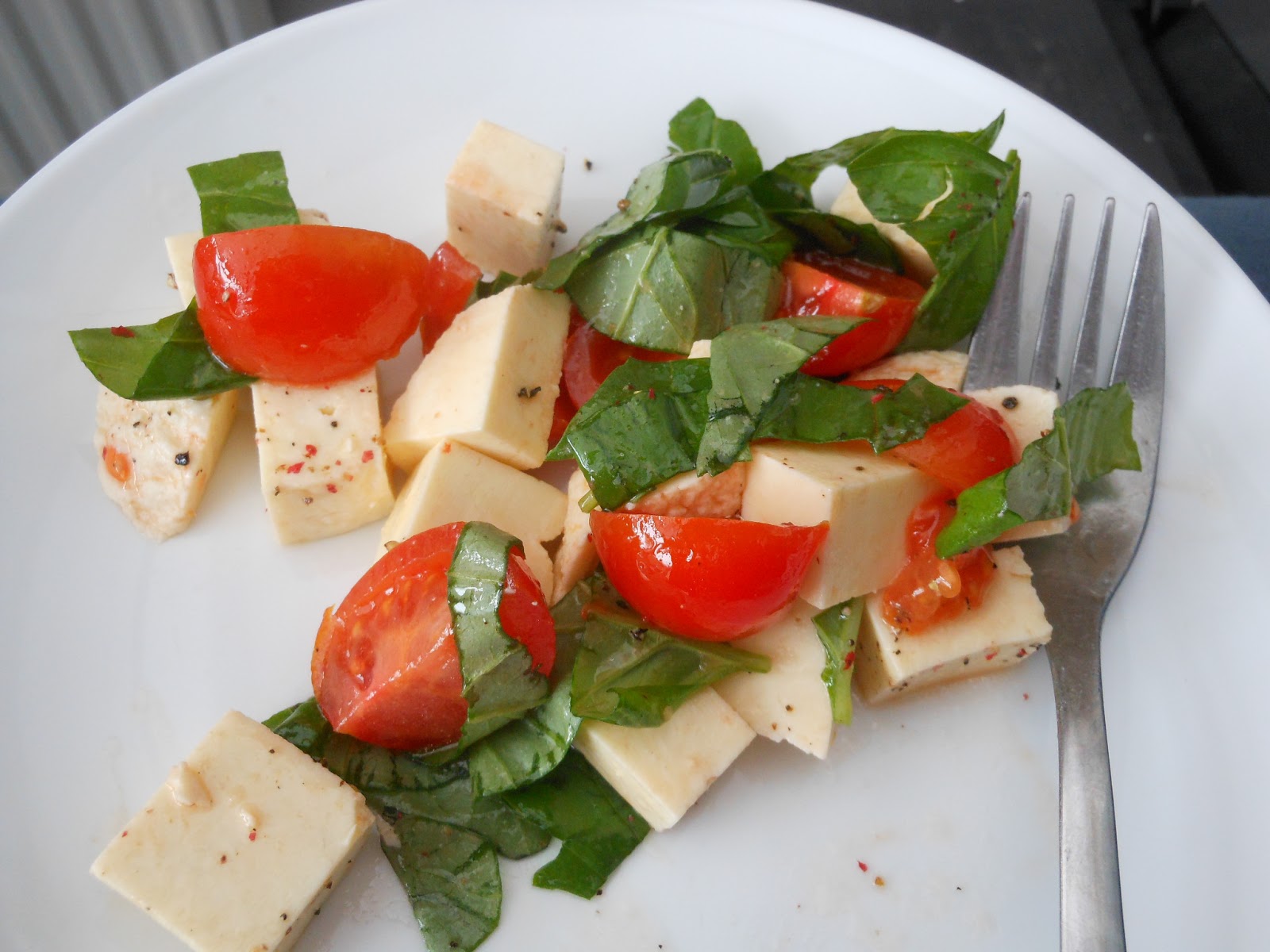
Basil, Mozzarella and Tomato salad
Taste good - but the texture is totally wrong; slightly granular and no stretch at all!

* The irony of this comment about tomatoes will not be wasted on anyone who has read the book - having tomatoes in March is exactly what the book is not about - it focuses on eating seasonal food that has been produced locally. While the tomatoes I have are from a local veg box scheme, the plants must have been heated to get them to produce fruit this early in the season so not very seasonal at all.

Tuesday, 26 June 2012

Tapas-style tea


Chilli spiced potatoes
Scrub the skins of some baby new potatoes and cut into pieces a bit bigger than an inch. Heat some olive oil, chilli oil and paprika in a frying pan then toss the potatoes in and coat the potatoes thoroughly. Turn the heat down low and cook for 15 - 20 minutes until golden browned and softened.

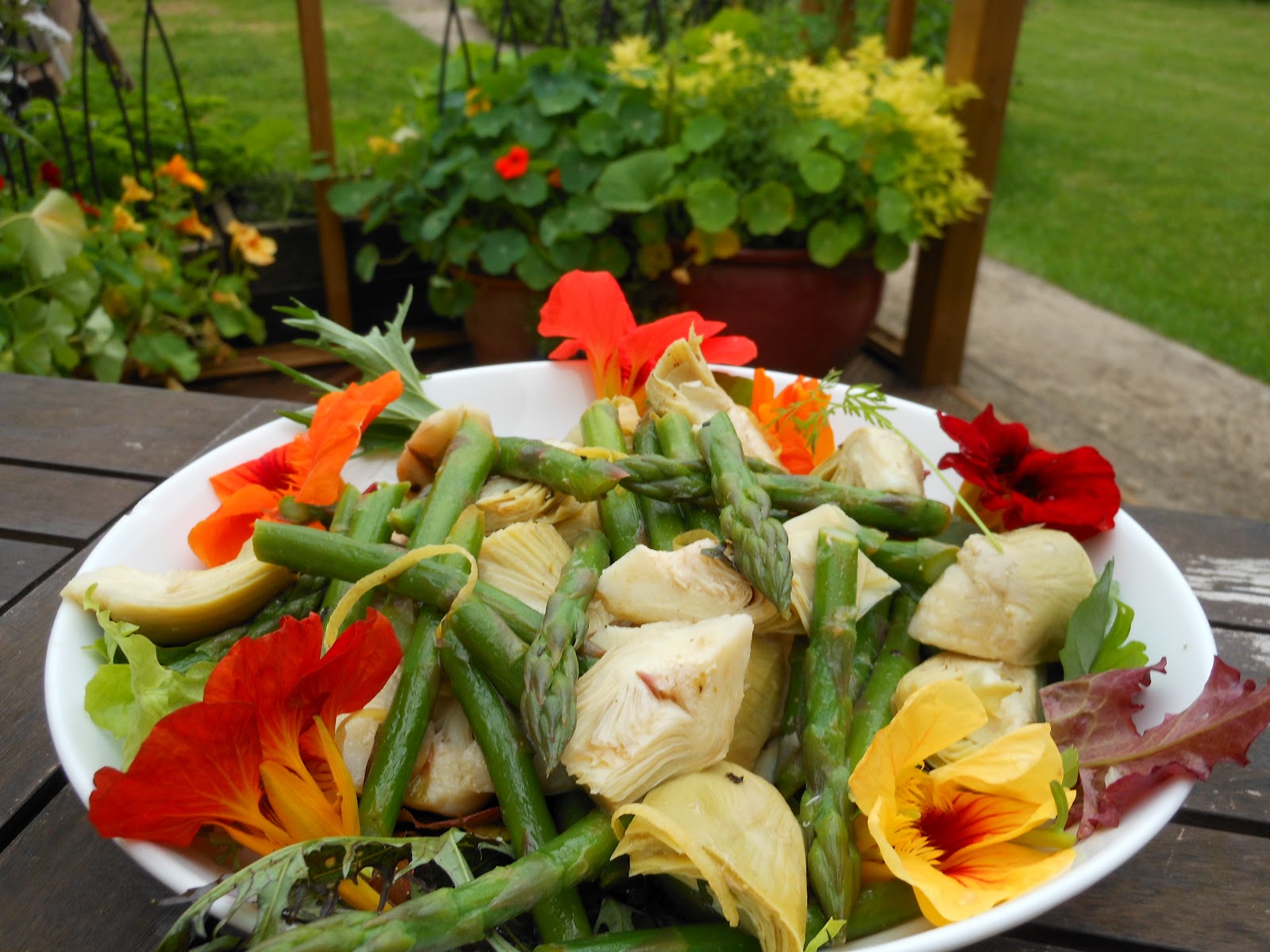
Artichoke and asparagus salad
Snap and discard the woody ends from some asparagus spears. Boil the asparagus spears in salted water for about 3 minutes, drain and set aside. Quarter some globe artichoke hearts and mix with the asparagus spears,  Add some lemon zest, lemon juice and sesame oil into the artichoke and asparagus and season with pepper.


Comfrey, hop, courgette and chipotle tortilla
Slice up some baby courgettes and gently fry in a frying pan with olive oil and some chopped spring onions.  Chop up a chipotle chilli (a smoked halapeno chilli pepper) and add to the courgettes and spring onions. Add some chopped comprey leaves to salted boiling water and simmer for 2 minutes, throw in some hope shoots, simmer for a further 30 seconds then drain and add to the courgette mix.  Mix about 4 eggs with some cottage cheese and pour over the vegetable mix in the frying pan. If you like it, chop up some goats cheese and sprinkle that over the top with some mozzarella. Continue to warm over a low heat until most of the egg mixture has set, then put under a hot grill to finish off the top and brown the cheese.

Plate the asparagus and artichoke hearts onto a bed of mixed leaves and nasturtium flowers.  Make a mint and cucumber raita to take off the heat from the chilli potatoes, and serve with big wedges of tortilla and salad.

Wednesday, 30 May 2012

Pea, hop shoot and goat cheese mezzaluna


I love the golden hops round the greenhouse - but they are misbehaving, sending suckers inside and then revelling in the heat and abundant water and crowding out my tomatoes - so it was time for another chop this evening.  I cut down a large handful of hop shoots (the top six inches of each shoot) and then realised that I didn't want omelette or fritatta which is how I normally eat them - instead I was rather keen to have some pasta.


So, I made pasta  using Doves Farm pasta flour mixed with egg yolks, and a tiny bit of water to bind, then rolled it into strips and cut out circles to make mezzaluna (half-moon).

The stuffing was made from an approximately equal mix of peas, hop shoots, goat cheese and mozzarella - slightly pureed down and then put into the pasta circles which were folded over and sealed. I boiled them for about 3 minutes then tossed them in melted butter with lemon zest, basil leaves and freshly ground black pepper.

I'm not sure that I could taste the hop shoots in there at all - maybe they don't add to the flavour - or just have a very delicate contribution to make? I think I'll try hop fritters next, or maybe one of my favourites: battered halloumi (a la Terre a Terre) on a bed of buttered hops - whatever, the hops are already planning their next greenhouse takeover so it won't be long.


Sunday, 27 May 2012

Comfrey and Fat Hen Pie

The smell of comfrey tea, a fantastic homemade fertiliser of plants, stewing in the water butt has always put me off eating comfrey myself. Until now.

The comfrey in the garden has grown ridiculously fast, and with the high winds this week, much has blown over forcing me to cut the first lot to make comfrey tea. So I took the opportunity to pick some of the best leaves for myself - with trepidation.

I started by blind baking a pie case that would end up a bit crunchy on the outside (I preferred it to a a very short pastry crust). The comfrey and fat hen were boiled for about 3 minutes - and actually smelled fantastic which I was not expecting! I then chopped them up and added them to a bechamel sauce to which I had added two egg yolks and some cottage cheese. This was all mixed up and put into the pastry crust, topped with some panko breadcrumbs and baked for 20-30 minutes.

I did not expect this to taste as good as it did, but I'm delighted to have found another leaf in the garden that can be used in place of spinach. Comfrey puts down incredibly long roots and is able to bring a lot of nutrients back to the surface - why its used to make liquid fertiliser for plants.  Fat Hen was traditionally used in cooking until mass-produced spinach replaced it. Hens also love it hence the name (and its effect on them apparently).

Recipe inspired by Rosamund Richardson's recipes for Fat Hen and Comfrey.

Thursday, 24 May 2012

Goats cheese ravioli


This is probably my favourite ravioli recipe - a good goat cheese ravioli cannot be beaten!

I mix lots of different cheeses - but always a good goat cheeses (and usually with a nice cheddar, some mozzarella and veggie parmesan) and use this to make ravioli.

Here I have served the ravioli with a creamy cherry tomato sauce with slivers of baby leeks and wilted mixed leaves from the garden.

Cheese wedding cake

Our cheese wedding cake (from the top layer down):
Cerney Vine
Truffled Pecorino
Godstone Cheddar
Colston Basset Stilton (half) and
Cornish Yarg

Cheese wedding invitations


We made our own wedding invitations: a Camembert box with homemade personalised labels and then the invite and instructions for the wedding inside.

Needless to say this resulted in a lot of Camembert cheeses needing to be eaten. The best way was to take a whole Camembert, put some slits in the top and insert slivers of garlic and springs of rosemary and then cook until oozing in the over. This worked wonderfully with potato wedges and fried polenta fingers - but would also make a wonderful fondue if you get the inside runny enough and then remove the top to dip bread in and scoop out the cheese.

A very simple pea ravioli recipe


Make  pasta; mix egg yolks, strong white flour and a bit of water into a firm dough and roll out into thin sheets.

For the filling mix peas (thawed petit pois or fresh from the garden and lightly cooked) with cottage cheese, goats cheese and some veggie parmesan - season and then liquidise briefly. Put dollops of the filling on the pasta, cover with another piece of pasta and form into raviolis squeezing all the air out.

Cook for about 2-3 minutes in boiling water and drain. Melt butter and add freshly ground pepper, a touch of chilli oil to give it a bit of a kick, some zested lemon rind and some sage leaves - toss the ravioli in this.

It also works well to melt the butter and just add some peas to that and then toss the ravioli into that.